May 2026 Newsletter
Our member garden this month:
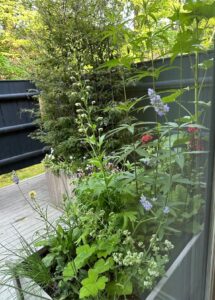
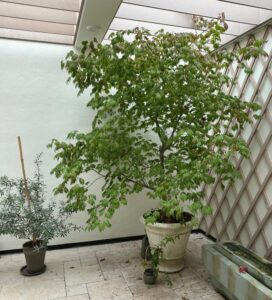
Erika Rodriguez has a sun filled deck and atrium where she tends lovingly to a kitchen garden filled with herbs and fragrant flowering trees. Pictured on her deck in a wooden box is an espalier beech tree. In her legged planter she has her annuals: delphinium, lemon geranium, thyme, oregano, chives and hollyhock. In her atrium she has a glorious maple tree in pot and an olive tree!
Letter from our President:
Upcoming Luncheon at the Concord Country Club:
Kelsey LeBuffe notes:
Please save the date – you are invited to the annual spring Club luncheon on the 17th of June at 11am in the the Barn room at the Concord Country Club. A sign up genius will go out this week. RSVPs are required by June 10th. Thank you!
Arbor Day Tree Planting a Tall Success:
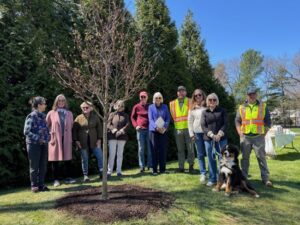
With much fanfare on Arbor Day, members of the garden club worked with the town arborist and planted a lovely tree in West Concord! The tree planted is a Sourwood. As noted in last month’s newsletter by Jane Rupley, it is a graceful native tree that blooms in mid summer with pendulous lily of the valley type flowers. It has spectacular fall color of brilliant scarlet. The tree requires acid soil and grows to about 30 ft. at maturity which grows in full sun for best flowering. West Concord near Ride Out Playground is the perfect spot for this tree!
The planting members include:Bean Nardi, Monique Halleck, Pam Nelson, Lauren Huyett, Rod Riedel, Jane Rupley, Eric, the town arborist, Tracey Lyne, Holly Salemy and Barli.
Art in Bloom behind the scenes notes:
By Sarah Béguelin
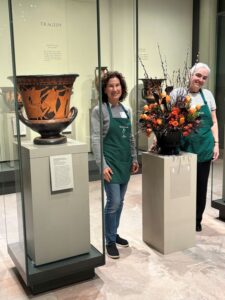
Our first impression was that the mixing bowl with the killing of Agamemnon depicts a stark and simple 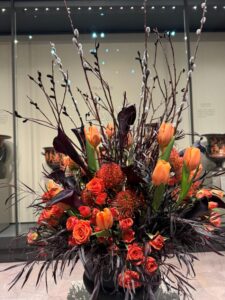 room with lots of black and terracotta objects. The bowl itself is dark in color but also fluid and violent. We love that it tells a story.
We approached our design from the bottom up (vessel first) and then color. We hope that we have done justice to this amazing piece. The container we chose for our arrangement was inspired by the low-profile footed bottom of the object. The object itself looks like a large bowl resting inside the smaller vessel with handles. We selected a dark container that was “antiqued” to represent the ancient Greek pottery.
The orange-toned terracotta inspired us to seek out intense orange-toned flowers. Other plant material represents the movement of the scene as the story of the death of Agamemnon is depicted wrapping around the bowl. One of us is participating in Art in Bloom for the first time, bringing in decades of experience as an artist. The other floral designer has participated several times in the past and looked forward to this new challenge of interpreting an ancient Greek ceramic.
Pictured are the Sarahs… Sarah Paino and Sarah Béguelin
Ellen Whitney adds:
What a treat it was to see the flower arrangement Sarah Begulin and Sarah Paino created for Art in Bloom last week! Their piece was in a room filled with greek amphora, and their flower arrangement brought the whole room to life! I’m sure you can see how they captured the color palette with deep, blackish purples and vibrant, fiery oranges — such a challenging palette to work with in spring! The range of tones and texture within that limited palette is fabulous, from the spiky protea, to the smooth and luscious tulips to the density of the roses. The black callas, agonis and pussy willow contrast in texture also add such interest and energy. Can you see that they even found black pussy willows?! The explosive design, where the energy in the center bursts out, energized the whole gallery.
A fun note from Bean Nardi: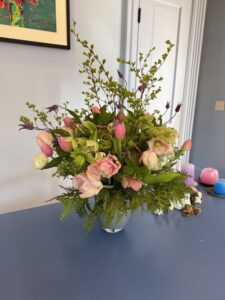
The auction item that keeps giving. Bean Nardi was the high bidder on the the flower arrangement item at our CGC auction in the fall. Ellen Whitney created a burst of spring with a magical floral display. The arrangement is filled wth hellebore, parrot tulips, regular tulips, queen anne’s lace, evergreen, bridal wreath spirea and cyclamen.
Field Trip Happenings:
By Nan Gustafson
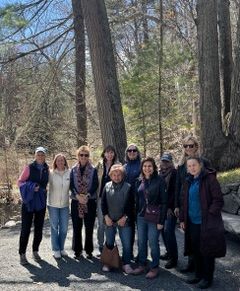
On April 23, 2026 a group traveled to the Garden in the Woods in Framingham, Massachusetts on a beautiful spring day. The 45 acre property is managed by and serves as the headquarters of the Native Plant Trust, the nation’s first plant conservation organization, whose mission is “to conserve and promote New England’s native plants to ensure healthy, biologically diverse landscapes.” The Native Plant Trust “saves native plants in the wild, grows them for gardens and restoration, and educates others on their value and use.” The Garden is the largest landscaped collection of New England native species, showcasing more than 1,000 species in a natural forest setting. Visitors can see, first hand, how native plants create healthy, beautiful landscapes which support local wildlife, pollinators, and soil systems.
The garden was founded in 1931, when landscape architect, Will Curtis, bought the property from a railroad company that had mined part of it for gravel deposited by glaciers. Curtis, who was trained by a pioneer of the Wild Garden Movement, was attracted to the natural beauty of the glacially shaped terrain consisting of ridges and steep sided valleys, with a pond, bog, and stream. He planned his design to “paint a peaceful picture of our land, as nature intended it.” Curtis and his partner, Dick Stiles, collected seeds and specimens from all over the continent to learn how to cultivate wild plants. They spent decades shaping trails and transplanting native plants, creating a “wild garden” that looked like natural New England habitats. When Curtis died in 1965, he left the garden to the New England Wild Flower Society (now the Native Plant Trust) as a “contribution to conservation.”
Our guides, Leslie and Betsy, led us along the mile long main trail of the Garden, which loops through the property, winding through various garden areas and ecosystems filled with plants native to New England. Although we were early in the season (in fact we were the garden’s first tour of the season), we were in awe of the natural beauty that surrounded us. The canopy was just beginning to leaf out, allowing light to shine through to the ground and us to see through the trees, into the distance. With the sparse foliage, we could see the glacial shaped terrain, the rock outcrops, glacial dips and winding paths.
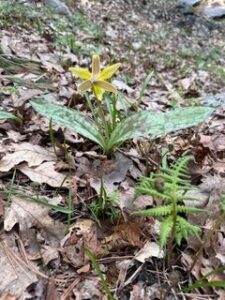
As we began our walk, we were immediately delighted to see many spring ephemerals growing through the beds of leaves, including trout lily, squirrel corn, hepatica, early blue cohosh, Jacob’s ladder, jeffersonia, and trilliums. We stopped at the Stock Beds, the behind the scenes growing area used by the Garden for propagating and maintaining native plants, crucial for keeping the garden supplied with native plants. We continued along the path, walking through the Idea Garden, which provides visitors with inspiration for their home gardens, specifically lawn replacement ideas with swaths of Mayapple, Wild strawberry, and Pennsylvania sedge.
We followed the winding trail gently downhill into the woods with patches of bloodroot, Virginia bluebells, and trilliums dotting the way, to the more cultivated part of the garden, the Curtis Woodland Garden. Here, a series of paths wind through the understory and near the stone remnants of the original homestead. Continuing along the path through the Woodland Gardens we saw dutchman’s breeches, large-flowered bellwort, spring beauty, trout lily, trilliums, and Viburnum lantanoides (Hobblebush) all in bloom, while catching glimpses of the Lily Pond, ahead of us, through the trees. Approaching the glacial kettle pond, our focus shifted to the dozens of turtles sunning themselves on a fallen log in the water. We walked around the pond, learning about the ecosystem and how the diverse plants cycle nutrients in the soil and water, attract insects and provide food and shelter for a variety of wildlife.
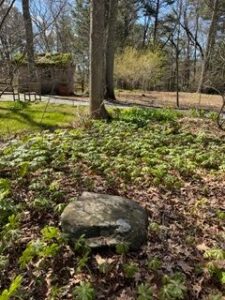
As we moved away from the pond, we climbed gently back uphill to an overlook, where we had a lovely view of the pond below, before continuing on through the Habitat Gardens. From here, the path loops back to the visitor’s center (our starting point), passing different distinct environments, or habitats, where specific New England native plants thrive. Descending through a ravine, the trail passes through Laurel Bend, a transitional garden, filled with Mountain Laurel. The trail levels out as it approaches the Swamp. Skunk cabbage fills the swamp, a sure sign of Spring. We passed by the meadow which is currently undergoing changes. Our final stop was the low lying Coastal Sand Plain, where we saw a swath of eastern prickly pear, New England’s only native cactus, and various other plants that grow in poor, sandy soils and harsh conditions, typical of the coast.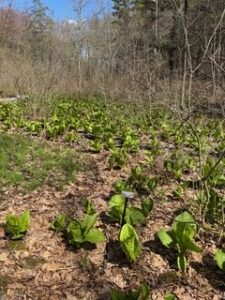
We all very much enjoyed our sunny morning learning more about the importance of native plants and seeing them in a beautiful, natural landscape. After our tour, some of us browsed the native plants for sale in their nursery, while others looked for unique finds in the gift shop. A group of us went to the Local in Wayland for a fun and delicious lunch.