Dear Members:
I can’t believe the year has flown by so fast! We certainly have had a very productive year in servicing the Concord community with nine outreach projects and creating a tenth project, Garden Therapy, for next year. We gave out twelve grants and a scholarship, offered six field trip opportunities, and held a stellar auction, which has allowed us to update our website. In addition, we provided wonderful programs, maintained two town gardens and are working on a third, welcomed over eight new members, and to top it off we held an extremely successful plant sale netting $11,022. Thank you to all who worked wholeheartedly behind the scenes, chaired and attended events, and supported the club in many other ways. We are who we are because of all of you!
Our Treasurer, Rod Riedel, will be closing the books by June 30th and is requesting all outstanding invoices please be emailed to him directly
or mailed to the PO Box by June 20th. We are asking all members to sign up to help maintain our two town gardens. Grab a friend or sign up with someone you do not know – I am sure you will make a new friend in the process! Here is the SUG
In case you missed our proposed by-law change in last month’s newsletter, I have included it again. Please see below.
We will discuss and vote on this proposed change at the Annual June Luncheon. Next year’s directory is currently being updated. If you have any changes to the directory please send them to either Pam Nelson or myself.
Please watch for 2026-2027 Committee SUG which will be coming out at the end of June. We have created a new committee for the upcoming 100th Anniversary in 2028.
I look forward to seeing all of you who RSVPed to the Annual June Luncheon this Wednesday, June 17th at 11:00AM!
Holly
Proposed by-law change information:
In keeping in line with the rest of the Garden Club Membership categories of members automatically moving into a category after being in the club for a certain length of time, Sustainer (25 years) and Honorary (40 years), I would like to propose removing the limited number of persons and the need to write a letter to the Membership Chair. Since creating the Sustainer category we have not had more than 19 people in the Associate category. This change will make it possible for the Membership Committee to predict how many openings we will have each year and keep us in line with our other categories. Please see the current and proposed by-law change below in yellow:
Current by-law:
Article lll – Membership:
B. Associate Membership
1. Associate Membership shall be limited to 30 persons.
2. Eligibility is based on 15 years of membership in good standing. Members must request such change in membership status in writing to the Membership Chair.
3. An Associate Member is required to pay annual dues, attend at least one meeting per year and volunteer for at least one club activity.
C. Sustaining Membership
1.Resident members who have been in good standing for
twenty five (25) years will be eligible for Sustaining
Membership.
Proposed change:
B. Associate Membership
1. Resident members who have been in good standing for
fifteen (15) years will become an Associate Member.
2. An Associate Member is required to pay annual dues, attend
at least one meeting per year and volunteer for at least one
club activity.
C. Sustaining Membership
1. Resident members who have been in good standing for
twenty five (25) years will become a Sustaining Member.
New Member Welcome:
We welcome three new members this month: Barbara Ewen, Kathryne Friess and Julia Paino. Their bios will be coming soon in the newsletter!
The Clock Town Barn Field Trip Notes:
Maryrose Sykes notes:
A large group of members visited the Gardens at Clock Barn, located in Carlisle, on Thursday, May 7th. Wow!! Such amazing and impressive gardens for us all to experience on a sunny spring afternoon. We were warmly greeted by Maureen Ruettgers, garden owner, and her two gardeners, Kristen Infanger and David Carr. Maureen shared with us some background information about the special exhibit in the Clock Barn, “Violets: A Celebration”, some recent changes and new additions to the property, a few challenges with deer and rabbits, and certain plants not to be missed during our self-guided walk in the gardens, including the flowering crabapple trees located in the Walled Garden and the ephemerals in the Woodland Garden. Not only was it a gift to have Maureen and her gardeners available for questions, but we were given another gift, a Jonny Jump Up violet in a small pot to take home. We also learned that two of our own members share their time and talent with the owners, Jo-Ann Lovejoy as a beekeeper and Erika Rodriguez as a floral arranger.
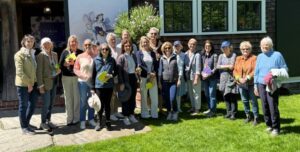
From left to right: Maryrose Sykes, Karen Perkins, Betsy Dorr, Nan Gustafson, Jane Coutre, Lisa Resnick, Kate Wharton, Sarah Paino, Elizabeth Salvi, Sarah MacEachern, Hilary Robinson, Wendy Page, Maureen Ruettgers (garden owner), Erika Rodriguez, Patricia Waters, Ellen Matheson, Pam Nelson, Jane Rupley
Missing from photo: Cathy Jenkins, Kelsey LeBuffe, Katie Wilson
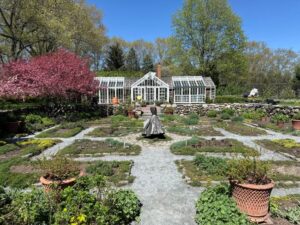
The property was originally owned by the Jonathan Blood family, farmers who established a cooperage (workplace of a person who makes, repairs or maintains wooden vessels) and the first local sawmill in the 1700’s. Elizabeth Blood’s father was the well-known Patriot, Simon Willard. During the 1930’s, the property was purchased by the family who owned Bates Ice Creamery (now Kimball’s). Drying ovens were developed in the old barn for a WPA project to cultivate and process digitalis (foxglove) for medicinal use. Today, digitalis is one of the few plants used in its pure form in medicine. The current owners, Maureen and Michael Ruettgers, purchased the property in 1980. They have implemented many changes in the gardens over the years, but are also known for expanding the 1930’s greenhouse and building the Clock Barn (1997), a post and beam structure constructed with 18th century beams, which features a working clock from 1895.
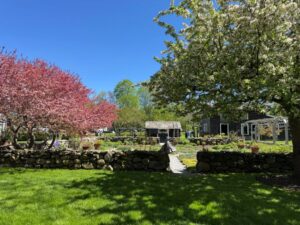
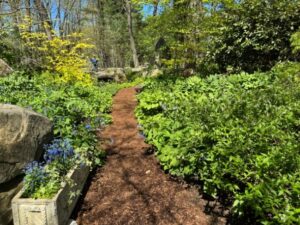
Upon entering an arched arbor, we had a view of expansive gardens. Gradually we meandered throughout a series of distinct garden spaces including a (1)Secret Garden, (2) Walled Garden arranged in four quadrants with thyme, onions, shallots, lavender, yarrow, pots from Italy with blueberries and rosemary, perennials on the border, and a beautiful sculpted dress in the middle, (3) Reflecting Pools that outline a path to the white-framed greenhouse, (4) Woodland Garden with a mulched winding path lined with Solomon’s seal, grape-hyacinth, yellow archangel, yellow and white daffodils, lemon balm, Canadian wild ginger, African witch hazel, mayapple, hosta, barrenwort, rhododendrons, ferns, Japanese maple, common blue violet, Virginia bluebells, sweet woodruff, bleeding hearts, creeping Jenny, dogwood, Jeffersonia diphylla, peony, lungwort, Japanese painted ferns, spirea, and hellebore (5) Orchard with apple trees, (6) Harvesting & Cutting Gardens, (7) Cordon Pear Garden and (8) Wildflower Garden.
Throughout these gardens there are special features, such as the following; (1) Clock Barn (circa 1997), (2) Drying Barn (circa 1790) with dried flowers and herbs harvested from the adjacent gardens, (3) Greenhouse (circa 1935), a focal point in the center of the property, with tender perennials, annuals, large Abyssinian bananas, bush lily, air plants, salvia, parsley, white sage, paprika, lemon verbena, fig trees, fruit tree, and a collection of scented geraniums-native to South Africa, (4) Tree Fort, and (5) Meditation Room. In addition, there are sculptures positioned in the garden spaces that represent artists from South Africa, France, Switzerland, Puerto Rico and the United States. Many of us were fascinated by the “Water Harp” (Wasserharfe), a bronze sculpture created by the Swiss artist Housi Knecht, located in an open space near the Woodland Garden and Pond.
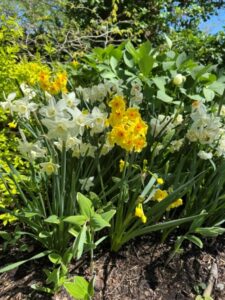
Each year the Ruettgers create a theme for a special exhibit in the Clock Barn. This year’s featured theme was “Violets: A Celebration”. These flowers have been a source of inspiration for gardeners, writers, bakers and artists of all kinds as seen in nature, literature, fashion and design. The displays presented in the Clock Barn provided everything you would want to know and more about violets. Upon entering the Clock Barn, there were different varieties of violets positioned in pots, including Becky Groves, Diana Groves, Reine de Neige, Little Plum, John Raddenbury, Queen Charlotte, Clive Groves, Carol Lockton, St. Helena, Lianne, and Josephine. It was particularly fascinating to learn that violets became very popular in the United States between the years of 1890 to 1920, inspired by Victorian England and its symbol of refinement and beauty. Duchess County, NY, known as America’s “Violet Belt”, became the leading producer of violets in the country. It is said that “the glare of sunlight reflecting off of the many greenhouses in Rhinebeck, NY gave the village its fitting nickname: Crystal City”.
 On view in the Clock Barn were display panels with some fascinating information about Isabella Stewart Gardner, given that violets were Isabella’s favorite flower. She grew numerous violet varieties in her greenhouses in Boston and Brookline. There was a description of an event attended by Isabella where she was described as being the “belle” among a group of women, exquisitely dressed with a “huge bouquet of Russian violets from her own conservatory”. In the Gardner Museum’s Short Gallery today, one can see violets in Joseph Blackburn’s portrait of an aristocratic woman. In the Titian Room, Isabella established a tradition of placing fresh violets in a Norwegian silver cup before Bellini’s painting Christ Carrying the Cross.
Another section of the barn displayed two beautiful posies and several “porte bouquets”, or small decorative objects for holding flowers. During the Victorian Age, they both often served as accessories during dinner parties or social events, freeing a person’s hands to dance or eat. Along the theme of dining, a large table in the barn presented different “culinary delights” having violets as an ingredient (candied flowers, syrups, honey, liquors, jelly, and granulated sugar). A plate full of delicious lemon cookies with a candied sugar violet design was available for visitors to sample. In a nearby corner, a gorgeous violet dress was on display, designed by Liz Moseley and inspired by J.J. Grandville’s interpretation of a violet flower in the book, Les Fleurs Animees.
There were also violet-themed pop-up displays throughout the gardens with fun facts, such as the following; (1)Violets are an asymmetric flower consisting of five petals in a variety of hues, (2) Violets are chosen by gardeners for their resilience, widespread growth, and recognition in local environments, (3) The violet is the State flower of Illinois, New Jersey, Rhode-Island and Wisconsin, (4) The Romans used violets in wine to prevent intoxication and to treat headaches, as the plants contain salicylic acid, a precursor to aspirin, (5) Violets are associated with Saint Valentine and have been a symbol of love, modesty and loyalty, (6) Violets have been cultivated as early as 320 BC by the Greeks, and (7) Viola odorata (sweet violet) is famous for its fragrance and used in the perfume industry.
We were all blown away and delighted to experience the Gardens at Clock Barn, an absolute masterpiece! For those members who did not have the opportunity to join us for this field trip, keep in mind that these gardens can be seen in the future through the Garden Conservancy’s Open Days.
The Garden Club of Concord Scholarship:
Joan Campbell notes:
Hunter Thin has been awarded this years Garden Club of Concord Scholarship. Hunter has a number of interests including track and field, ski team, and green team. Green team is an environmental club that provides volunteer opportunities and spreads knowledge especially throughout the town including the elementary schools. His favorite classes at CCHS were health and fitness, and organic chemistry, both of which examine how the body works. Areas of interest in college are biochemistry and business which he will pursue while studying at UMass Amherst. He really likes the potential opportunities UMass offers. Over the summers he works as a camp counselor at MIT, teaching swim lessons. He plans to work there again this summer and do some traveling to Canada this summer. Hunter uses his difficult times in his school years to make him a stronger person.
Outings Around Neighboring Towns:
Kate Wharton suggests attending a Spring Guided Nature Walk of Wheeler Farm in Lincoln. This walk is specializing in plant ID and plant diagnosis. June 17, 9:45-12:00. Interested members can sign up via Lincoln Land Conservation Trust website.