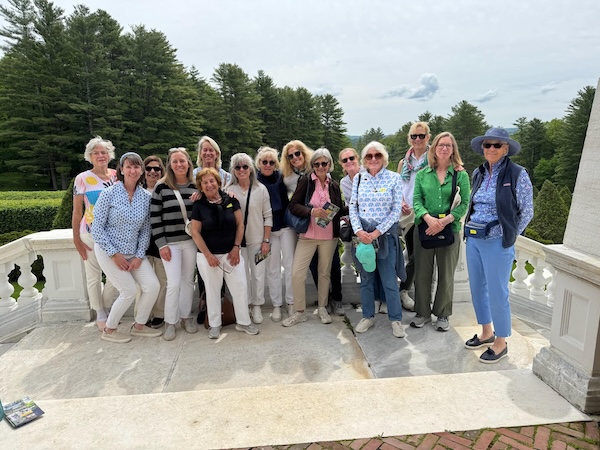
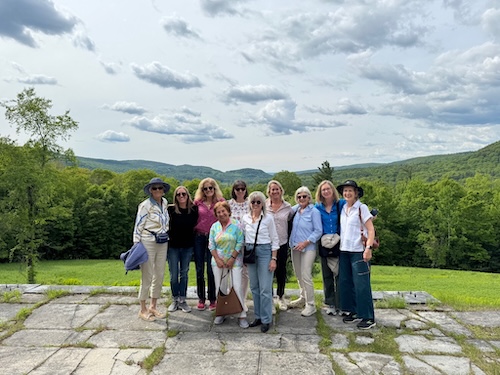
Left to right: Kate Warton, Maryrose Sykes, Amal Moamar, Nan Gustafson, Joan Campbell, Sarah MacEachern, Paula Casey, Holly Salemy, Pam Callahan, Lauren Huyett, Jen Lannan, Kathy Venne, Sarah Garland-Hoch, Ellen Whitney, Jane Rupley
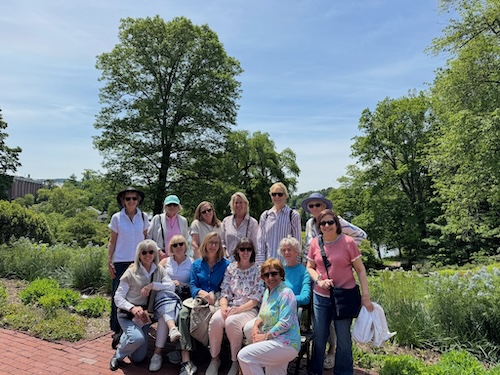
From left to right: Amal Moamar, Holly Salemy, Jen Lannan, Maryrose Sykes, Paula Casey, Ellen Whitney, Joan Campbell, Nan Gustafson, Kate Warton, Pam Callahan, Lauren Huyett, Sarah MacEachern, Kelley Bothe
Maryrose Sykes and Nan Gustafson write:
The recent three-day, two night field trip to the Berkshires was a success with 16 members staying in Lenox, MA while enjoying five private tours and one self-guided tour of the Botanic Garden at Smith College, Ashintully, The Mount, Naumkeag, Chesterwood and the Berkshire Botanical Garden. The group had two great full days of sunshine and one partly cloudy day – such a surprise given the weather forecast.
Our first day included a private tour of the Botanic Garden at Smith College with Blanch and Margaret as our guides, and a self-guided tour of Ashintully in Tyringham. We enjoyed lunch at Coolidge Park Cafe at The Hotel North Hampton, and dinner at Frankie’s in Lenox.
Botanic Garden at Smith College
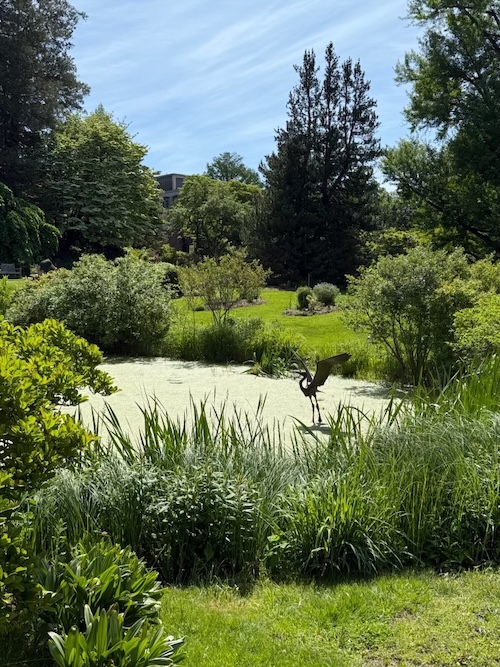
The history of the Botanic Garden at Smith College dates back over 125 years and is rooted in the formation of the college campus. The first president of Smith College, L. Clark Seelye, believed in science education for women and envisioned the entire campus as an arboretum and botanic garden to provide students with a strong foundation in the natural sciences. The Botanic Garden of Smith College was established in 1895 as part of the original landscape design for the college campus created by the landscape architecture firm F. L. Olmstead. Over time the garden has evolved into a living museum, encompassing a wide variety of plant collections from around the world and includes 126 acres of arboretum, six acres of managed outdoor gardens, and the Lyman Plant House, a 12,000 square foot conservatory, originally constructed in 1895. Today, the Botanic Garden supports education, research, and conservation, while offering beauty and inspiration to the Smith College community and the public.
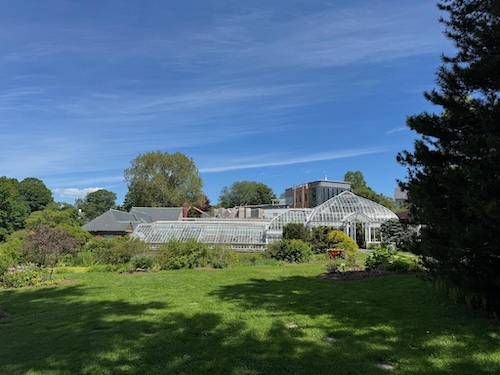
Our guided tour focused on the two outside gardens adjacent to the Lyman Conservatory, the Ruth Brown Richardson Perennial Border and the Systematics Garden. The Perennial Border, which runs along a wrought iron fence, is filled with an array of colors and textures, including irises, amsonia, and peonies which were in bloom during our visit. One of the oldest gardens on campus, the Systematics Gardens serves as a living exhibit of plant evolution and classification. This garden exhibits a diverse array of flowering plant species, arranged in beds to reflect the current understanding of their evolutionary relationships. A small pond and a huge Ginko tree, which is over a century old, serve as focal points of the garden. Much to our surprise, our guide was extremely experienced and knowledgeable in foraging and volunteered much information about how she enjoys preparing and eating many of the plant species in these gardens, including american wisteria, sweet fern, black locust, poke weed, spicebush, and aronia.
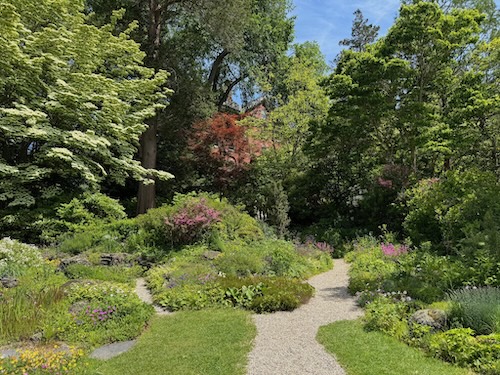
After our guided tour, our group explored the Smith College Rock Garden, one of the oldest rock gardens in the United States, which was created in 1897 and inspired by the rock garden at the Royal Botanic Gardens, Kew Gardens, in London, as well as the Happy Chace ‘28 Garden, a terraced garden behind the president’s house, overlooking Paradise Pond and Mount Tom, where the aroma of flowering lilacs filled the air.
Ashintully
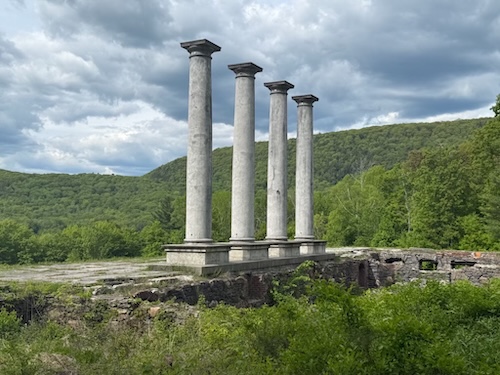
In the early 20th century, Robb de Peyster Tytus and his wife purchased 1,000 acres of land, representing three former farms in Tyringham and additional land in Otis. The property was called Ashintully, a Gaelic word meaning “on the brow of the hill”. A grand Georgian-style mansion was designed by Francis Hopping and built with 35 rooms, 10 baths and 15 fireplaces, featuring four Doric columns with 13 bay windows overlooking the valley on the side of Round Mountain. The local residents called the “Berkshire Cottage” a “Marble Palace” because of how the white stucco exterior, with sand brought in from Nantucket, reflected the sunlight. In 1952, the manor home was destroyed by a fire caused by the owner burning trash under windy, drought conditions. Today, the ruined foundation and the portico Doric Columns remain.
Tytus’s son, John McLennan, acquired the property in 1937, slowly clearing the overgrown land and creating a serene retreat. He was a self-educated gardener with an understanding of spatial relationship, form and proportion. Without a master plan, McLennan allowed the natural sloping landforms, trees and water features guide his design. Upon entering the lower gardens from the barn, the land’s existing features include a quiet meandering brook, mature deciduous trees, and low fieldstone walls that frame the rolling terrain.
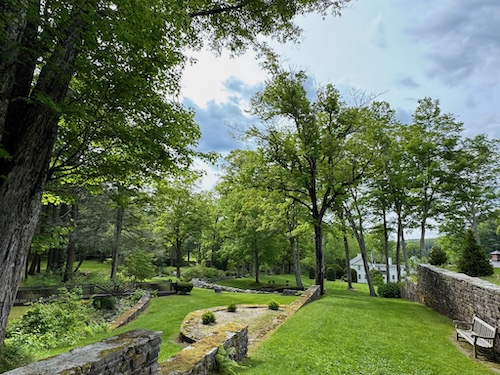
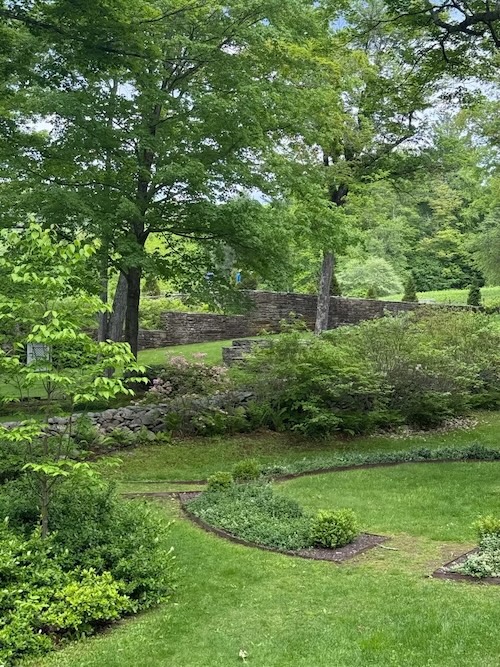
There is a footbridge crossing the stream and grassy terraces with classical statuary, urns and benches. On the edge of this area, there are a set of stone steps built into the hill accessing the meadowlands that are backed by more hills in the distance. There is a steep woodland trail, about a half mile, from the lower gardens to the “Marble Palace”ruins above. Various shade plants are visible to travelers along the woodland trails, such as ostrich and marginal wood ferns, astilbe, trillium and lily of the valley.
The view from the terrace with the Doric Column remains is spectacular, as one stands among the columns overseeing the Tyringham Valley and Bartholomew’s Cobble. One can return to the lower gardens by walking the Old Carriage Path or taking the woodland trail in reverse. Ashintully is currently owned and maintained by the Trustees of Reservations.
We began our second day with a private tour of the gardens at The Mount in Lenox with Anne as our guide, and lunch on the terrace. Kate Wharton coordinated a surprise private tour of the house following lunch, with time spent at the wonderful gift shop. What a treat!! Later in the afternoon, we had a private tour of Naumkeag in Stockbridge with Kendra as our guide, and dinner at Firefly in Lenox.
The Mount
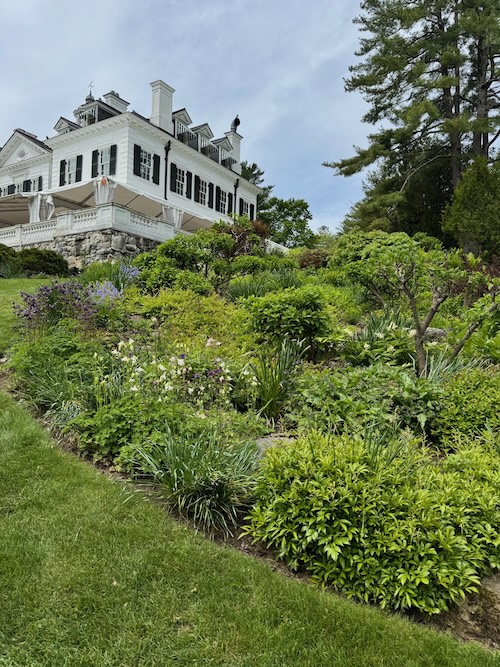
In 1902, at the age of 39, Edith Wharton began designing and building The Mount, reflecting her architectural and landscape design theories, along with the assistance of Ogden Codman, Jr. and Thomas Reynolds, a landscape horticulturist. She favored classical design with a focus on symmetry, balance and proportion, as opposed to victorian style design. Her approach incorporated the love of light and reflection, bringing the outside inside. Unfortunately, she never retained the original architectural and landscape plans, creating challenges while undergoing the restoration process in recent years. However, she was known to “love structure and improve on beauty within her garden design”.
There have been several changes in the vegetation over the years, but a magnificent original American black birch remains, anchoring the informal Rock Garden with trunks balancing each other and trillium and ferns at the tree’s foundation. An eastern white pine also anchors the Rock Garden that predates the Whartons. The Rock Garden is lined with oak leaf hydrangea, hibiscus, lavender and a butterfly bush. Grass steps cut in the side of the hillside and serve as a surprise element in this garden.
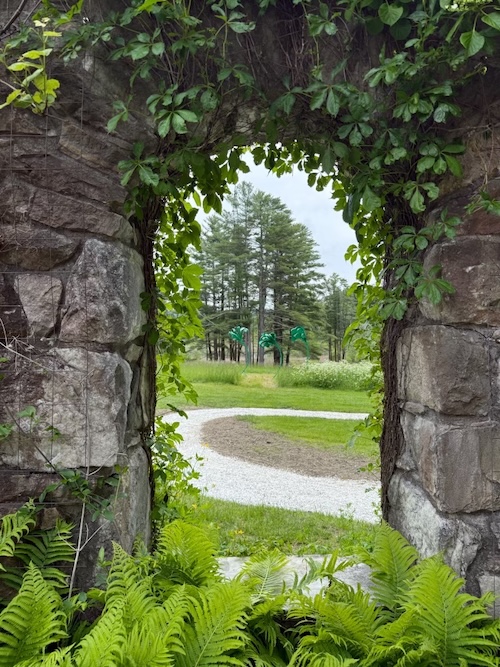
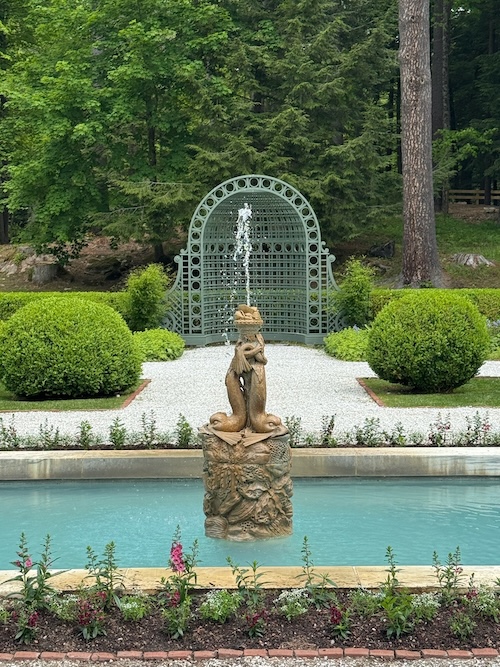
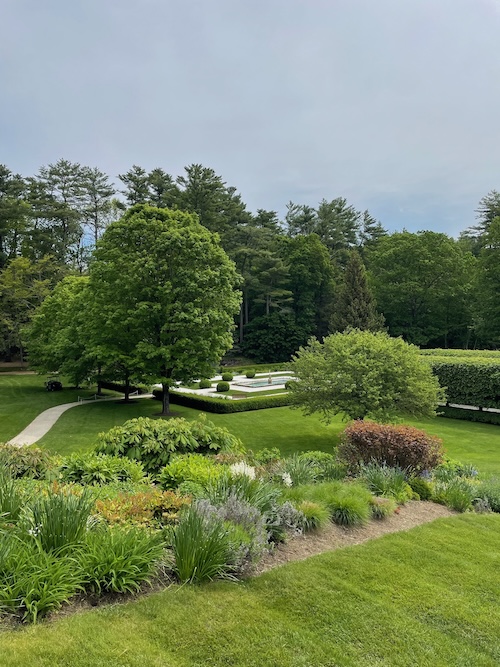
The Italian inspired terrace was intended to extend the living area outside of the house, providing steps away from the house towards nature. There are various rooms below the terrace including the formal Italian Walled Garden with a green and white theme, and a formal French Flower Garden with a vast selection of perennials intending to create a “mass bloom”. A “lime walk” lined with 20 year old trimmed European linden trees “frame the view”, connecting the Italian Walled Garden and the French Flower Garden. One accesses these areas by using the local marble stairs from the terrace. Beyond these garden rooms are the Laurel Beaver Pond and Laurel Lake with a meadow in between. Edith experienced tension between formal and informal approaches to the garden, reflecting the differences in her heart and mind. The Mount is an impressive property, a National Historic Landmark, public park and cultural center that reflects the incredible legacy of Edith Wharton.
The Naumkeag estate is a historic hillside property known for its architectural significance, elaborate gardens, and sweeping views. A quintessential Gilded Age estate, Naumkeag was established in the late 19th century as a summer residence for Joseph Hodges Choate, a prominent New York attorney and US Ambassador to the United Kingdom, and his wife Caroline Dutcher Sterling Choate, an artist, advocate for women’s education, and co-founder of Barnard College. The 44 room, Shingle-style “cottage” was designed and built by architect Stanford White, of McKim, Mead, and White, in 1885-1886 and the surrounding landscape was designed by Nathan Barrett, a self taught landscape architect, with formal terraces and ornamental plantings.
Their daughter, Mabel Choate, inherited the 48 acre property in 1929 and spent the next 30 years transforming the original gardens into a playground for the imagination. In 1926, Mabel met landscape architect, Fletcher Steele, at a Lenox Garden Club gathering, which began their 30 year collaboration in reimagining, remaking and expanding the estate’s gardens. Together, they created magnificent garden rooms including the Afternoon Garden, Blue Steps, and Chinese Garden, which were whimsical and filled with movement and color.
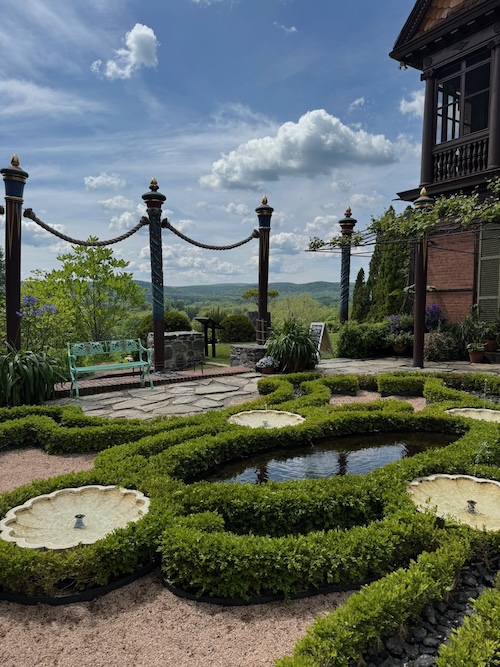
The Afternoon Garden, the first outdoor room created by Choate and Steele, is framed in a series of Venetian gondola poles and includes intricate boxwood parterre, grape arbor, fountains, brightly painted ironwork benches, and many varieties of potted fuchsias.
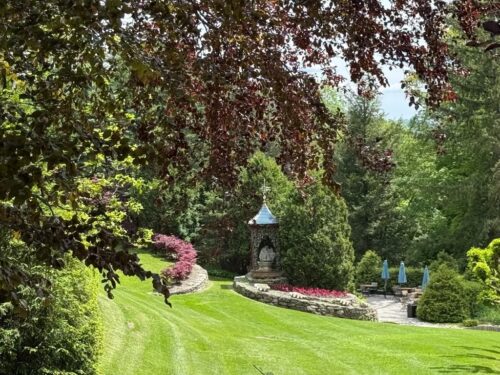
The South Lawn, which connects the Afternoon Garden to the Pagoda and the Linden Allee was reshaped into a flowing curve, echoing the mountain ridge in the distance. Rond Point, a gathering of paths, was created to connect the Linden Allee, woodland paths and the regraded lawns.
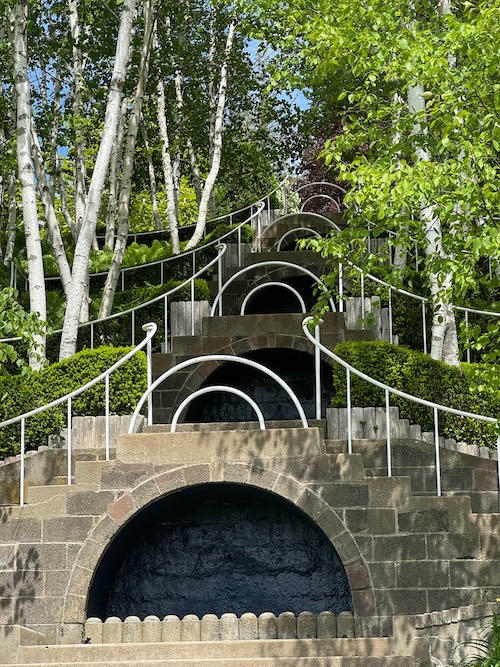
The Blue Steps, cascading like a waterfall down the hillside, were designed and built to provide access to Mabel’s cutting garden. A series of terraces below the cottage were created for Choate’s oriental tree peonies. The Chinese Garden, which took 20 years to create, includes a temple with a blue tiled roof, moving water, a circle shaped moon gate which leads directly to the front of the house and completes the circuits of gardens of Naumkeag.

Upon her death in 1958, Mabel Choate left Naumkeag in its entirety, including all of the household furnishings and fine art, to the Trustees. The main house was listed on the National Register of Historic Places in 1975 and in 2007 the entire estate was designated a National Historic Landmark District for its architectural and landscape significance. Naumkeag remains a well preserved example of a Gilded Age country estate and provides people the opportunity to experience the combination of historic architecture and innovative garden design.
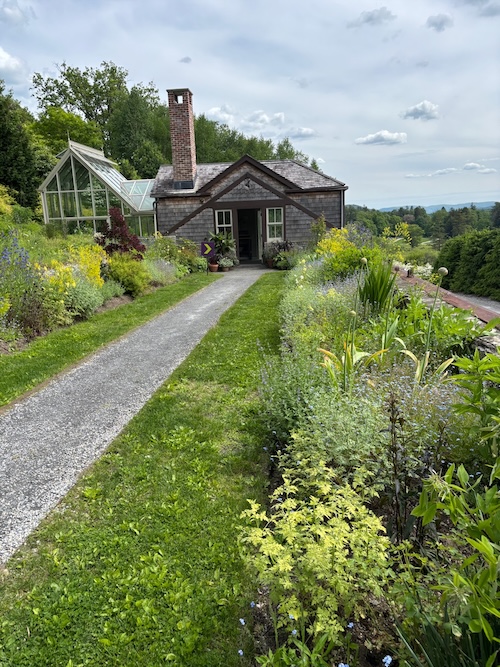
Our last day started with a private tour at Chesterwood in Stockbridge with Ben and Nancy as our guides, and lunch in town at Michael’s. We ended our field trip with a private tour of the Berkshire Botanical Garden with Carol as our guide.
Chesterwood
In 1896, Daniel Chester French purchased about 120 acres for $3,000 in what is known today as Chesterwood, intending to develop a summer estate and studio with surrounding mountain views. French never completed his studies at MIT, but applied his scientific and creative mind to becoming one of the most successful sculptors of the 20th century, and landscaping this property. His father more than likely had great influence on French’s interest in gardening, since his father had been President of the Massachusetts Agricultural College, now part of the University of Massachusetts. We learned during our tour that French’s father, Henry Flagg French, was the inventor of the French drain.
The main garden is located adjacent to the studio where the doorway to the formal garden is flanked by hemlocks. A brick wall partially encloses the space along with a lilac hedge, dividing the space with different softness and textures. In one corner of the garden (east side), there is an intimate, contemplative, shaded area with ferns. French designed the garden with a series of outdoor rooms with natural features, using the woods to provide a natural border and contrast of the north and west side of the garden.
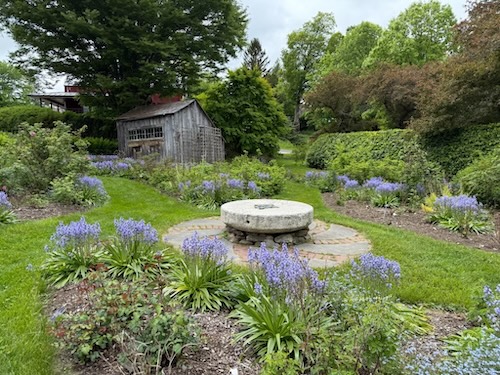
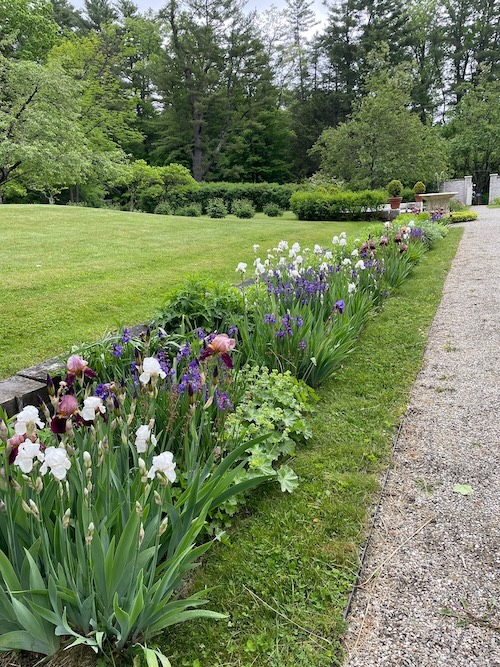
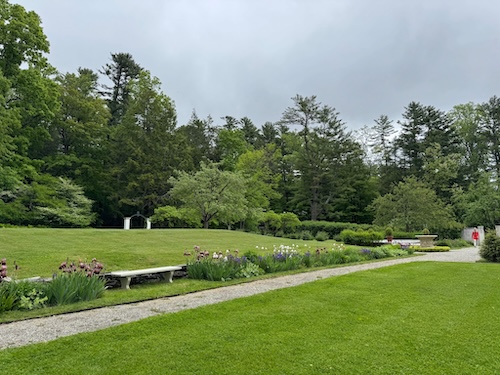
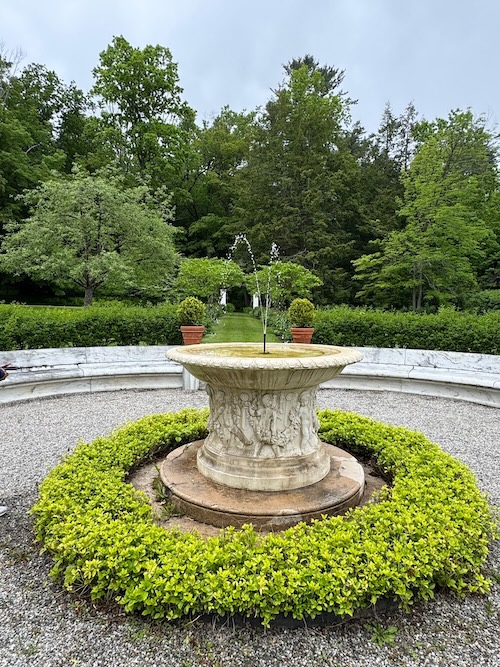
Upon entering the garden, one sees a perennial garden with different pastel-colored iris, bleeding hearts, lilies, and hosta. The viewer immediately gravitates toward a semi-circle graveled courtyard with a marble-cement fountain at its center, designed by Henry Bacon – a focal point to this formal garden. There are curved marble benches that surround the fountain with privet bushes above.
In one direction from the courtyard, there are steps leading to the elevated lawn with a walkway lined with beautiful hydrangea and peony, a straight vista into the woodland circle. In another direction, one views a glade, or opening leading to trail systems, where tall white-glazed terracotta columns mark an access to the woodland walk. The stone path towards the glade has another perennial garden with lady’s mantle, astilbe, iris and baptisia.
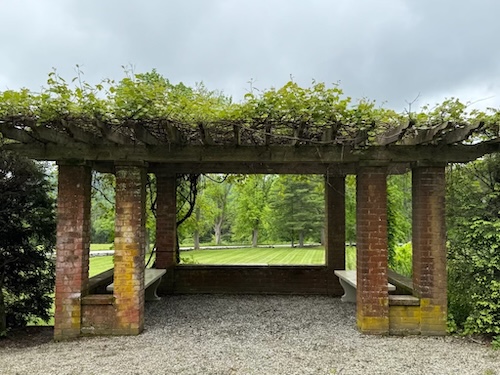
On the south side of the studio, a pergola is draped with Concord grapes, set in a row of hemlocks, providing a view of the Berkshire Hills and the pasture. This is a pleasant resting spot referred to as the Overlook. Daniel Chester French’s only child, Margaret, gave the property to the National Trust for Historic Preservation in 1973. There are plans for the garden at Chesterwood to undergo a renovation beginning this summer.
Berkshire Botanical Garden
Established in 1936 as the “Berkshire Garden Center”, the Berskshire Botanical Garden was one of the earliest public display gardens in the Northeast and is a blend of historic charm and modern vibrancy. A “museum of living things,” the Berskshire Botanical Garden’s 24 acres is a showcase of horticulture and garden design. The BBG is a not-for-profit, membership-supported organization whose mission is to “provide information, education and inspiration concerning science, art and joy of gardening and its role in preserving the environment.”
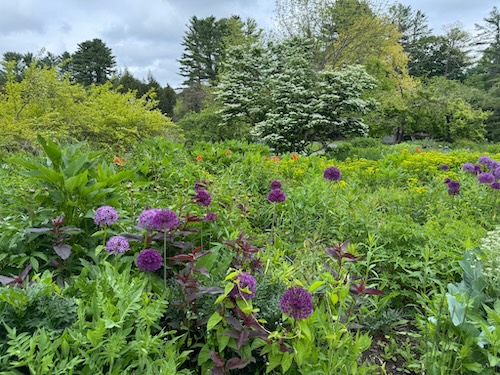
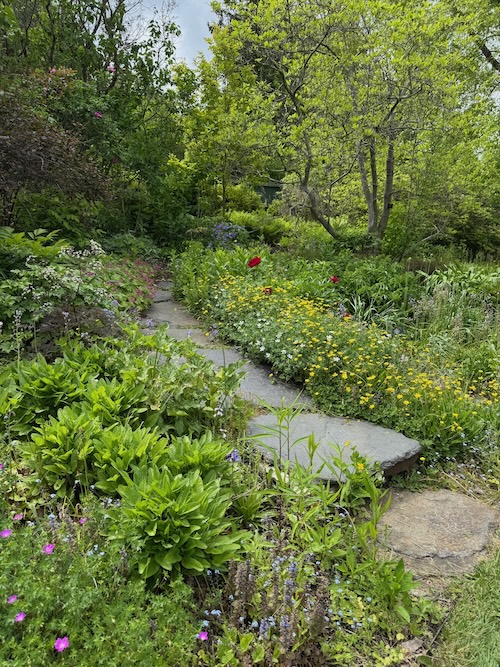
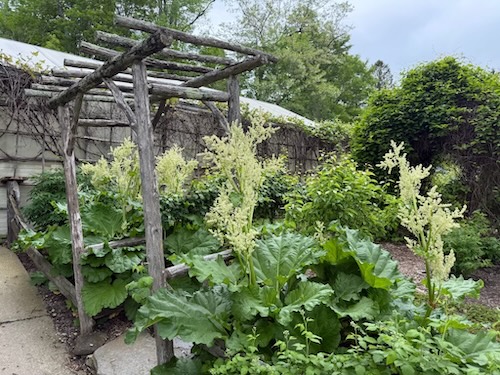
The grounds contain dozens of unique garden spaces and plant collections are educational, functional, and highly ornamental, featuring over 3,000 plant species and varieties. Some of the unique spaces we saw on our tour included several mixed border gardens, the raised bed vegetable garden, the Children’s Discovery Garden, the rain garden, greenhouses, tree collections, the historic 1937 herb garden, perennial border gardens for sun and shade, the rose garden, the woodland garden, and a whimsical topiary collection.