Club Trip to the Cotswolds and the Chelsea Flower Show
Nan Gustafson and Maryrose Sykes write:
A group of 14 GCC members traveled in May to England on a field trip. We spent four days in the Cotswolds, followed by two days in London.
Below is a description of our time spent on the trip.
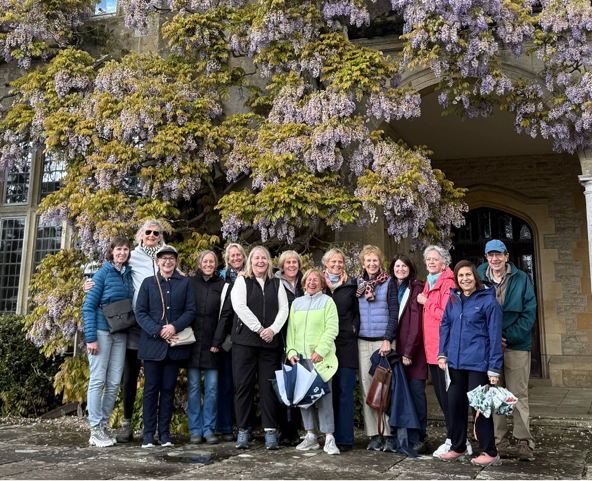 Left to right: Maryrose Sykes, Hilary Robinson, Faye Allen, Nan Gustafson, Sarah MacEachern, Kathy Ticknor, Holly Salemy, Joan Campbell, Madelene Wilson, Kelley Bothe, Patricia Waters, Kate Wharton, Amal Moamar, John Althouse (Photo taken at the Garden at Miserden Park)
Day 1- Sunday, May 17th
Soon after arriving at our hotel (the Manor House Hotel) in Moreton-in-Marsh, we departed from the town center towards Batsford Arboretum, walking a portion of Monarch’s Way (about 1.7 miles), a picturesque footpath with open fields and grazing sheep. We enjoyed lunch at the arboretum cafe prior to taking our self-guided tour.
Batsford Arboretum
Batsford Arboretum was started by Bertram Mitford, the 1st Earl Redesdale, who inherited the estate in 1886. His experience in the Foreign Office as British attaché to Russia, China and Japan formed a life-long interest in plants from this region. With the help of Kew’s Director, Joseph Hooker, Lord Redesdale designed and planted a wild woodland garden with influences from Asia. Today, you see Mitford’s influence with the building of a Japanese Rest House and bronze statues of Buddha, Japanese Sika deer and a Foo dog.
In 1918, Sir Gilbert Hamilton Wills, later the 1st Lord Dulverton, purchased the property. His wife, Victoria, cared for the garden and added several trees, many of which still stand today. Currently, the large manor house located on the grounds of Batsford Arboretum is owned by Gilbert Michael Hamilton Wills, 3rd Lord Dulverton.
The arboretum experienced neglect during WWII, requiring some significant restoration under the ownership of the Second Lord Dulverton in 1956. He was less concerned with the family’s tobacco company and had a great passion for trees and understanding of forestry and arboriculture. Ten years later, the first arboretum catalog listed more than 800 plant species, such as notable collections of magnolia, oak, maple, cherry and rowan. In 1983, Batsford Arboretum was donated to a charitable trust to help ensure its future and develop a program of conservation and education.
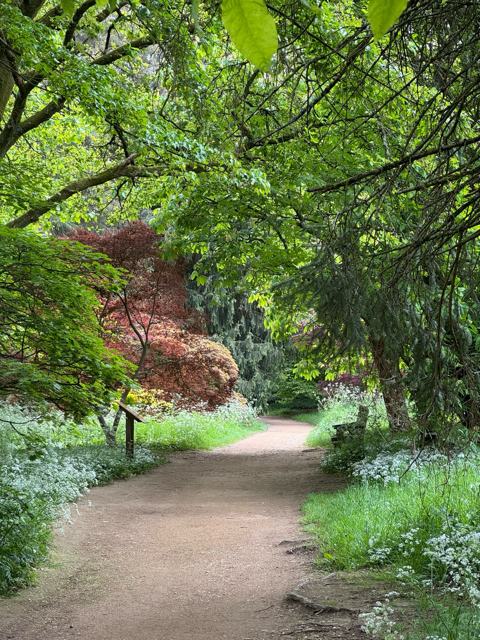
The Batsford Arboretum is currently known for their beautiful trees, shrubs and bamboos across 60 acres. It also provides a valuable habitat for many animals, birds, fungi, lichen and mosses. Some highlights during our visit included a flowering Pocket Handkerchief tree, Whitebeams (sorbus), Foxglove tree, Alliums, Welch Poppies, scented Smilacina (false Solomon’s seal), Lilac trees and Deutzias.
We were all moved by the “Anne Frank” tree, a living sapling grown from a cutting of a sapling from the original horse chestnut tree that Anne watched from her attic in Amsterdam. This serves as a living memorial to Anne and her enduring message of hope.
Day 2- Monday, May 18th
We departed at 8:30am for our planned adventures at Miserdan, Lords of the Manor and a walk of a portion of Warden’s Way in the villages of Upper Slaughter, Lower Slaughter and Bourton-on-the-Water.
Our driver, Mark, offered to stop at Stow-on-the-Wold, a town near Moreton-in-Marsh. We were thrilled at the opportunity, visiting two incredible sites: (1) the back door of St. Edward’s Church, a medieval church known for its ancient north door, framed by two towering Yew trees, said to have inspired J.R.R. Tolkien’s “Doors of Durin” in The Lord of the Rings, and (2) a historic property dating back to 947 AD with one of England’s oldest pubs, currently known as The Porch House.
Stow-on-the-Wold is the highest town in the Cotswolds at 800 feet above sea level. Most of the buildings around the market square date back to the 17th, 18th and 19th-century including the present-day library (St. Edward’s Hall). There are many cute shops in the town.
Miserden
We arrived at Miserden Park and were greeted by the staff. Prior to our visit, we made special arrangements to have a tour of the house by the current owner, Nicholas Wills, a private garden tour led by garden historian, Marion Mako, and light refreshments in the library on a day when the garden is not open to the public. It was an amazing experience, especially because the house is not available to the public when the garden is open to the public.
Miserden Park is a grand Jacobean manor with expansive, intricately laid out grounds, currently having 850 acres of woodland, farmland and gardens. The entire estate encompasses 3,000 acres and includes much of the village of Miserden. The house was built in the early 17th-century by the Sandys family. This magical, multifaceted estate in a Cotswolds hamlet, also called Miserden, has evolved with each successive owner. Like his prior family members, Nicholas takes a very hands-on approach in maintaining the garden. He also has two full time and part-time gardeners.
Nicholas’ great grandfather, Captain Frederik Noel Hamilton Wills bought the property in 1913. He was the son of Sir Frederick Wills of Northmoor, Dulverton who was the director of WD & HO Wills, which later merged into the Imperial Tobacco company, and a member of parliament. Captain Wills was educated at Clifton College and Magdalen College, Oxford and became very wealthy when he inherited a portion of his father’s estate in 1909. Education was very important to him. He ultimately made his mark with the foundation of Rendcomb College, opening in 1920 with twelve boys.
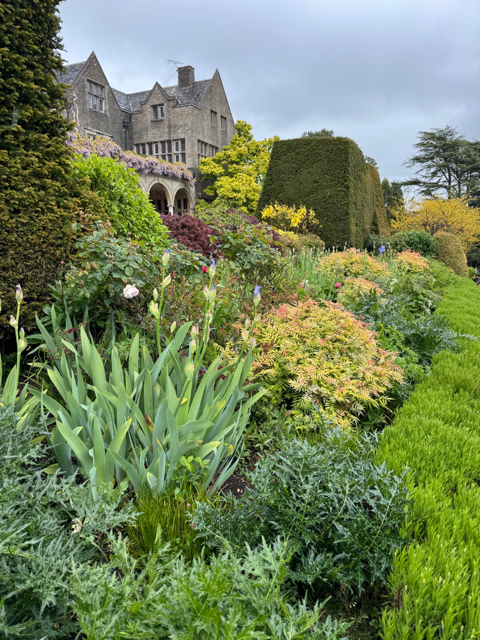
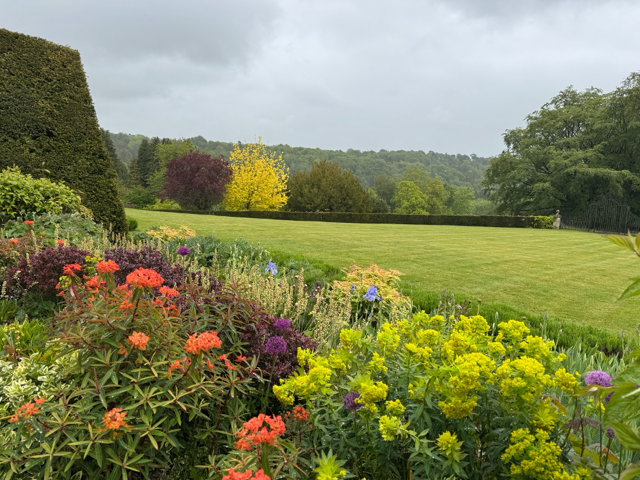
Frederick Noel Hamilton Wills commissioned Sir Edwin Lutyens to design a new east wing with an arched loggia after the house was damaged by a fire. The five bay arched loggia beautifully frames the manor house and opens onto a York-stone flagged terrace overlooking sweeping views of the Golden Valley and deer park. Lutyens also created a striking Yew walk with crenellations echoing those of the logia, and quaint grass steps. The house provides a wonderful backdrop to the Garden. We were lucky to have experienced the garden with the Wisteria in full bloom.
Nicholas’ father, Major Tom Wills, Coldstream Guards, (appointed Lieutenant of the Royal Victorian Order by Queen Elizabeth II), moved into the estate in 1980 and devoted about 40 years of maintaining his mother’s legacy of gardening where she had planted peonies, roses and hellebores in border gardens. He made his own additions, inspired by his passion for trees and forestry. In 2013, he planted a circle of lime trees opposite the house marking the centenary of the Wills family owning Miserden Park. He also created an arboretum by planting 75 percent of its trees.
There are magnificent long, wide herbaceous borders that flank a central lawn. They are some of the longest privately owned borders. This area contains different types of roses, clematis, shrubs and herbaceous plants providing mauve, pink and white colors from spring to autumn. Miserden has been defined as one of the top 10 most romantic gardens in the world according to Gardens Illustrated. Also, they were the winner of the Historic Houses Garden of the year in 2018.
You can’t miss the impressive 250-year-old sycamore tree which took root in the walled garden. Another key feature is an ancient mulberry tree believed to be planted in 1620 after King James I decreed that landowners plant one to help establish a silk industry. To mark the new millennium, two new features were added (1) a rill garden which has a fountain and (2) an Arts and Crafts-style summerhouse made of reclaimed timber and stone found on the estate.
During our introduction with Nicholas and his discussion of the house’s history, we stood in a large entrance room with an impressive tapestry hanging on one wall above a wooden table with several antiquities. Two things that stood out were ancient metal armored helmets, probably dating back to roman times. As it turns out, one of Nicholas’ relatives was digging in the garden and she happened to accidentally discover these helmets on the property. The area on the property was declared “restricted”, given the historical nature of the helmets. It was hard to imagine, but incredibly fascinating!!
In 2016, Nicholas assumed responsibility of the Estate, building on the family approach to sustainable forestry. He and his forestry staff work towards a clear intent “to maintain diverse, resilient, continuous-cover woodland that maximizes natural regeneration, supports a wide variety of flora and fauna, and balances both commercial and environmental aims”.
The woodland is typical of the Costwolds having beech, ash, oak, sycamore, lime, cherry, conifers and larch. Ash trees are the second most dominant tree after the beech, about 40% of the woodland at the Estate. It has been a challenge addressing the ash tree boar. As ash trees have been removed, Nicholas and his team have planted over 48,000 whips (young, slender, unbranched trees). They look like sticks, but they establish and adapt to new environments much faster than larger, older potted trees. To safeguard against future tree diseases, he has replanted with a diverse selection of trees including beech, oak, lime, walnut, hornbeam, birch, field maple, wild pear, Douglas fir, larch and Norway spruce.
Nicholas is also very committed to reducing the property’s carbon footprint. He has installed two biomass boilers providing heat and hot water for all the properties in the village. There is an effort to undergo sustainable thinning of the woodland producing enough timber to supply the boiler. It’s very possible that this is the largest privately funded, retrofit biomass plant in the country.
The Estate works at habitat management intending to have significant environmental benefits. This includes hedgerow management to provide shelter and a source of food for birds and dormice, uncultivated fields offering an extended habitat for all wildlife and planting seed and nectar producing crops for insects such as bees and butterflies.
Following our tour of the garden, we returned to the house for “light” refreshments in the library. This proved to be more than light with the serving of a variety of tea sandwiches, different cakes and tea. We all ate at the long wooden table in the library surrounded by the Wills family antiquities including an original Turner painting. It was an amazing experience!!
Although it was hard to leave the extravagant, historical Miserdan Park, we had a commitment to attend an afternoon tea at Lords of the Manor, a hotel in the village of Upper Slaughter, in a private room overlooking the property’s gardens.
Following our tea at Lords of the Manor, our bus driver, Mark, guided us on a short walk around Upper Slaughter, an idyllic village known for an Anglican parish church dating back to the 12th-century, its honey-colored stone cottages and the calm River Eye. There is no commercial development in the town, and the town is one of the few villages in the UK that did not lose any residents in WWI or WWII.
After our tour of the town, we proceeded along Warden’s Way, meandering through an open field and walking along the River Eye. Shortly thereafter (about 1 mile), we were greeted by an old 19th-century watermill in Lower Slaughter. The name of the village is derived from the Old English term “slough” meaning “wet land”.
Lower Slaughter is a quintessential, unspoiled village with 2-foot bridges, offering a peaceful setting with 16th-century limestone cottages. We all laughed while passing a resident’s door with a message on the door saying, “No, not you again”. After rounding the bend, passing the charming Slaughter’s Country Inn, we were greeted by several friendly cows.
We continued our walk towards Bourton-on-the-Water, another two miles further. Before reaching the busy road in the next town, we saw a group of horses galloping on the hillside, eager for their feeding. Mark reconnected with us at this section of Warden’s Way, quite helpful as we crossed into town.
Bourton-on-the-Water is known as “Venice of the Cotswolds” with the River Windrush traveling through its center, and five low, arched stone bridges. A few people visited The Model Village, a detailed 1/9th scale replica of the village (a bit over-rated). Others window shopped and admired beautiful purple and white lilac trees, and a blue blossom tree. The day was full of adventures!
Day 3 – Tuesday, May 19th
We departed a bit later today (10am) allowing the group to visit the Moreton-in-Marsh Market.
As part of our scenic drive to our first garden, we stopped at the well-known English country destination, Broadway Tower. The Broadway Tower & Park is a family-owned property with 200 acres of parkland. The tower is an iconic landmark on top of Beacon Hill (1,024 ft above sea level) offering panoramic views of up to 16 counties.
The structure was built in 1798 as a “folly”, or an extravagant building constructed primarily for aesthetic appeal instead of practical use. Over the years, it served as a holiday retreat for artists, such as William Morris, and an aircraft observation post during WWII.
As we continued our scenic drive, we saw canola flowers in fields, and crimson clover and thyme in other fields. The area is also covered with vast, wide, green fields of wheat and barley. What an amazing sight to see the open, colorful, rolling fields as we traveled throughout the area!
There are also extensive dry stone walls across the landscape totaling more than 4,000 miles and serving as boundaries and livestock barriers. The walls are built with jagged rocks, ‘cock and hen’ cope capping stones. The beauty of the walls is naturally enhanced by mosses and lichens adding their patina.
Kiftsgate Court Gardens
The first garden of the day was Kiftsgate Court Gardens, an exceptional family-created garden that has evolved across three generations of women gardeners. Famous for the Kiftsgate rose and sweeping herbaceous borders, the garden blends historic charm with bold contemporary features. It remains privately owned and maintained and is a continuously evolving English country garden.
We were greeted by the current owner, Anne Chambers, who led our private tour. She started the tour at the side of the manor house with the Georgian façade and a high portico, standing on the raised terrace overlooking a paved area divided into four beds with a sundial as the central feature.
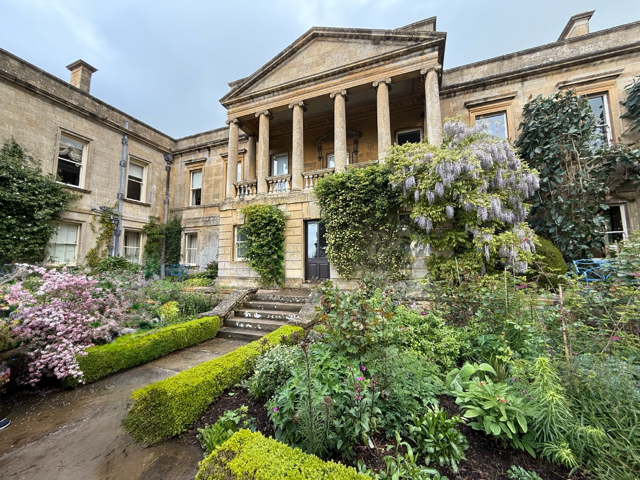
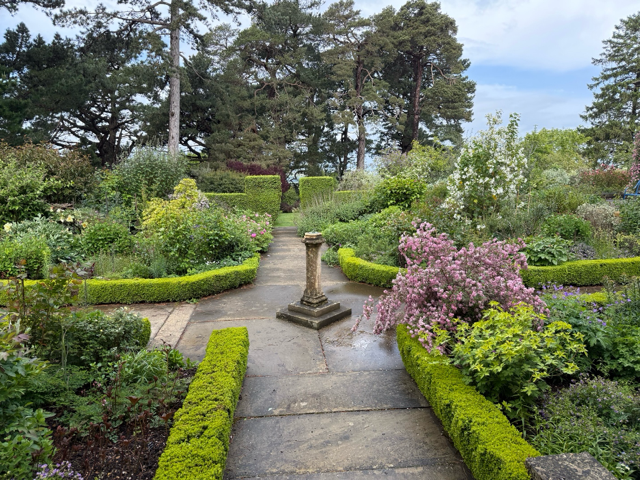
The large manor home was built in 1887 and moved to its current location on Glyde Hill, about one mile from its original location. When Anne Chamber’s grandparents purchased the property in 1919 there was only one garden, a rose garden located below the wooded hillside.
Soon Anne’s grandmother, Heather Muir, laid out a garden in the upper areas surrounding the house. Hedges were planted, paths laid and a bridge built to connect the Yellow and Wide borders. In the early 1930’s the steep banks southwest of the house were changed. Italian gardeners terraced them and steps were built to the lawn below.
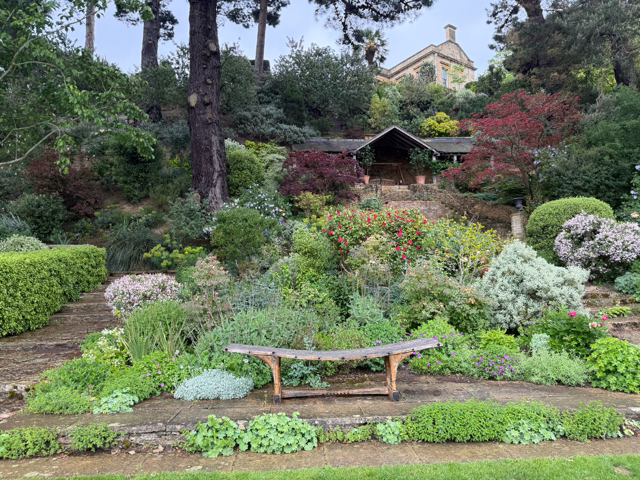
Color played a large part in Heather Muir’s designs and even now her ideas guide Anne Chamber’s planting. Currently, the Yellow border has foliage with varying shapes and colors mixed with herbaceous plants of blue, yellow and orange. The Wide borders have a color scheme of pinks and purples with grey foliage and a grass path running down the middle.
During the 1960’s, Anne’s mother, Diany Binny, had the semi-circular swimming pool built in the Lower Garden. The view from the pool stretches out over the hillside into a small valley. She also commissioned two sculptures during the 1970’s. The White Sunk Garden was redesigned by her to incorporate a small pool and a fountain. Gradually this formal garden has changed with more varied colors introduced into the area.
In the late 1990’s, Anne and Johnny Chambers converted the old tennis court into a Water Garden with a sculpture, very modern in design with no plants. The elegant fountain with stainless steel stems topped with gilded bronze leaves reflect well in the black water. Black algae were added to the water to change its color.
Other changes by the Chambers include developing a perennial wildflowers and grasses garden, an orchard with apple, medlar and quince trees, a horseshoe shaped mound created from tons of soil removed when the new Water Garden was created, and the avenue that was planted with tulip trees leading to a sculpture.
The vibrant, large-scale borders at Kiftsgate rival neighboring Hidcote for color and complexity. The sunken gardens, pool terraces and seating areas with dramatic views are impressive. The woodland walk provides shady pathways leading to hidden corners and varying seasonal interest.
Only two full-time gardeners maintain this incredible garden!! It is obvious that Anne Chambers is a hands-on owner/gardener and she is very involved with the always changing and evolving gardens. She was very generous in spending time with us.
Following our tour, we enjoyed lunch in The Tearoom at Kiftsgate.
Before visiting our second garden of the day, we traveled to Dover’s Hill, another viewing site in the Cotswolds. We experienced amazing panoramic views over the Vale of Evesham and began our short walk for a portion of the Cotswolds Way to Chipping Campden. We walked among the flowers (Cow Parsley), sheep, and hedgerows with an eventual view of rooftops in the town below.
Prior to our walk, we learned that the area is owned by the National Trust. Dover’s Hill is the site known for hosting the historic annual Cotswolds Olympics. We were three days shy of seeing this historic event where dangerous competitive events are undertaken by men and women. One event is called “shin kicking” (began in 1612) where the participants hold each other’s shoulders with straight arms while kicking each other’s shins. The person who remains standing and achieves the most throws after three rounds is the winner. Steel toe caps are no longer allowed, and straw is now allowed to pad shins.
We had a very short amount of time to visit Chipping Campden, known for its terraced High Street with 14th to 17th-century stone buildings. The town center is where The Cotswolds Way, 102-mile walking trail, officially begins (or ends). The village is also famous for its idyllic historic cottages. Most of us used our time to walk to a neighborhood with homes that had a breathtaking row of thatched houses.
Hidcote Manor Garden
Our visit at Hidcote Manor Garden began with a private short talk about the history of the property. Following, we had a self-guided tour of the gardens.
The American-born British soldier and self-taught horticulturist, Major Lawrence Johnston spent 40 years creating the 10.5-acre gardens at Hidcote, after his mother, Gertrude Winthrop, bought the 300-acre lot in 1907. Gertrude was born into a wealthy New York Waterbury family whose money came from the rope-making industry, and her first husband, Elliott Johnston, came from an equally wealthy Baltimore banking family. She was a socialite and her interest to be closely connected with other Americans having a great interest in British culture drew her to this location, near the village of Broadway.
Hidcote represents one of Britain’s most significant Arts and Crafts gardens. Johnston broke new ground in garden design, creating a series of outdoor “rooms” each with its own distinct character and planting scheme. The series of distinct garden spaces are separated by hedges, walls or structures. With each turn, the visitor has a surprised sense of discovery.
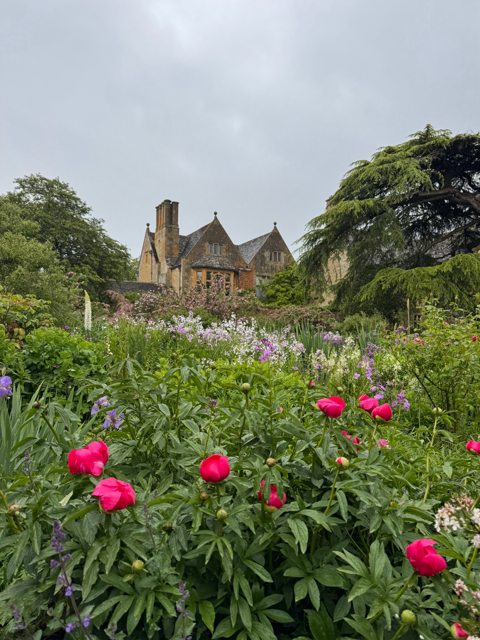
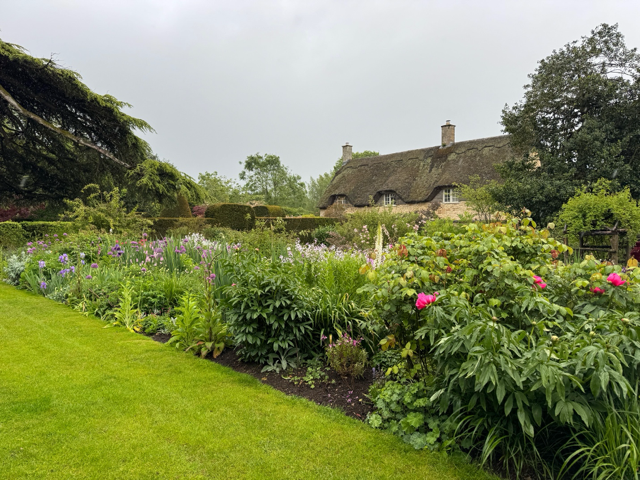
There is a maze of narrow paved pathways and secret gardens, magnificent vistas and plants that burst with color. A perfect place to visit for garden inspiration. The gardens are always changing and evolving.
The American author Edith Wharton described the garden as “tormentingly perfect”. In the 1930’s, the well-respected garden designer Russell Page acknowledged that Hidcote had influenced him more than any other garden. Johnston had pushed the boundaries of manor-house gardening “to plant in bold and unexpected ways”.
Visitors move through intimate formal areas around the house to the naturalistic wider spaces further away. The manor house sits between two enclosed courtyards that provide intimacy and enclosed formality of the Arts and Crafts style-garden rooms. The Old Garden, Maple Garden and White Garden are close to the house and display traditional manor-house gardening with successional planting softening the edges, but each area having its own distinctive feeling.
The “central axis” of the garden starts to open the garden spaces allowing the visitor to experience longer views with different shapes and contrasting colors. The Lilac Circle, Red Borders, Gazebos and Stilt Garden contribute to this garden ambition.
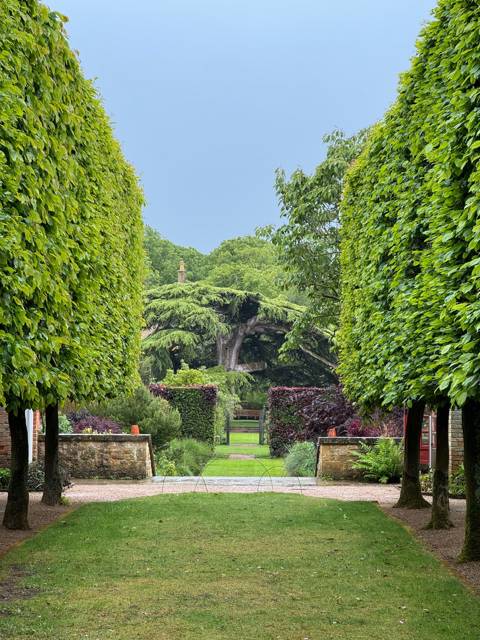
There are several areas in the garden that create a sense of intimacy stepping through the walls of yew including the Fuchsia Garden, Bathing Pool Garden, Italian Shelter, Poppy Garden and Green Circle.
Two enclosed gardens on the property have a southerly exposure growing tender species that might otherwise struggle in the English culture: The Pillar Garden and Mrs. Winthrop’s Garden. These creative garden rooms are both highly unusual and intimate with features such as clipped yew pillars, and fastigate (narrowing towards the top) cherry trees that rise through mounds of geraniums planted at the base.
Many parts of the garden have detailed, abundant and luxurious planting, whereas others provide the simple pleasure of long vistas framed by statuesque features, hedges and trees. The Long Walk, Great Lawn, Beech Allee and Lime Arbor are examples where one can enjoy the simple pleasure of being outdoors.
Johnston was an avid plant collector who traveled extensively in Africa, Asia and Europe’s Alps bringing back rare specimens to Hidcote. He also introduced over 70 plants into cultivation like the Hidcote Lavender, a popular shrub in many gardens, and the Lawrence Johnston Verbena. He was very involved in the RHS (Royal Horticultural Society) as a Fellow, judge at the Chelsea Flower Show, and member of the RHS Lily Committee. During his life, he received RHS awards of Merit.
Lawrence Johnston never married. In 1948, he transferred the Deed for Hidcote Manor, garden and estate to the National Trust. Ten years later, he died in Menton in the south of France, an area where he owned property since 1942. His mother also happened to pass away in the same area at age 80 about twenty years earlier. Today, The National Trust continues to maintain Hidcote for future generations.
After departing from Hidcote and before returning to Moreton-in-Marsh, we drove to two villages. The first one was called Snowshill, a quiet, picturesque village with a steep hill and narrow, winding lanes, just three miles south of Broadway. It has a traditional village green but is most famous for serving as a filming location for Bridget Jones Diary.
We also drove to the town of Broadway, sometimes referred to as the “Jewell of the Cotswolds”. The main broad street is lined with horse chestnut trees and honeyed-colored Cotswold limestone buildings dating from the 16th-century. The village is known for its association with the Arts and Crafts movements. It has a history of well-known artists and writers including William Morris and John Singer Sergeant
Day 4 – Wednesday, May 20th
We departed from the hotel in Moreton-in-Marsh, arriving at Sudeley Castle for a 10am private tour by the Head Gardener.
Sudeley Castle
Some of Sudeley Castle’s gardens date back to the 15th century when the castle was built by Ralph Boteler. At the time, the gardens had practical purposes of flavoring foods, scenting rooms and making medicines. The structure was a folly, never intending to have a military purpose. The property was abandoned for 200 years and fell into disrepair, until The Dents restored the castle and the gardens. After WWII and in more recent times, distinguished gardeners have worked with Elizabeth, Lady Ashcombe to re-imagine and maintain the gardens, considering the historic and majestic backdrop of the castle.
Our tour guide walked us through seven gardens. (1) Tithe Barn Garden is a romantic garden by a koi carp pond. The 15th century barn was partly destroyed by Cromwell in the Civil War. This is now the backdrop for a romantic garden of old-fashioned flowers including roses, hollyhocks, cardoons, hydrangeas, wisteria and wild clematis. (2) Magnola Walk is just beyond the Tithe Barn. We moved along the path under a large Atlas Cedar and passed Magnolias, Dogwoods and lots of Cow Parsley. (3) Mulberry Garden was planted by Emma Dent in the 19th century, the daughter of a silk manufacturer. The leaves on mulberry trees are the silkworm’s only source of food. We learned that the Black Mulberry was introduced to England by King James I intending to cultivate the silkworm. However, James imported the wrong species and therefore his attempt failed. (4) Ruins Garden has as its backdrop a partially destroyed 15th-century Banqueting Hall. The ruins have been planted to create a wild and untouched appearance. The windows are hung with curtains of clematis and roses. (5) Knot Garden was created in 1995 as a sheltered courtyard garden with 1,200 box plants forming an intricate geometric design with a Moorish fountain as the centerpiece. The design is based on a dress worn by Queen Elizabeth I in a famous painting called, “The Allegory of the Tudor Succession”. At one end of the garden, two trained pears have been placed on either side of the wrought iron arbor. (6) Queen Elizabeth Garden is a small garden in a corner of the ruins. It is the oldest surviving part of the castle with walls dating back to the 12th century. There is a topiary of the Queen’s dress, like one she would have worn to a banquet. (7) Queen’s Garden is named after four of England’s Queens (Anne Boleyn, Katharine Parr, Lady Jane Grey and Elizabeth I), a centerpiece of Sudeley’s gardens and bordered by great double hedges of yew. It has been redesigned over the years, but today it has more than 80 varieties of roses. The roses are underplanted with Linaria, Nepeta and Asters.
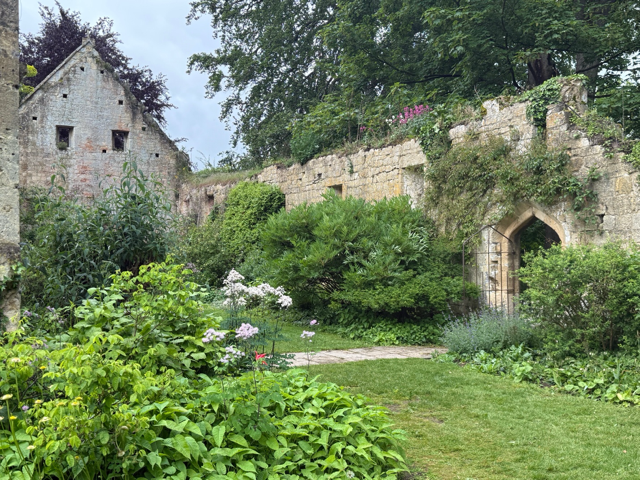
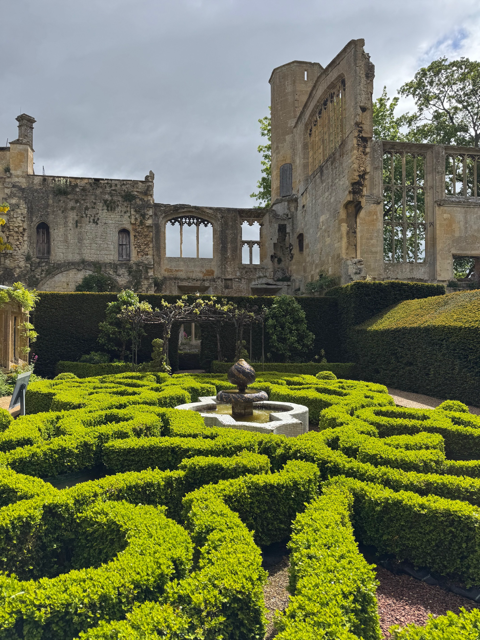
Following our private garden tour, we moved to the Orangery for a historic talk of Sudeley Castle. The property has had private and royal ownership throughout its history. Richard III, Henry VIII, Lady Jane Grey, Elizabeth I and Charles I are some of the royalties featured in the Castle’s story.
Many of us were not very familiar with the details of England’s extensive history. We were presented with lots of information from the early 1000’s, including the ‘de Sudeley’ family, to the present private owner of Elizabeth Lady Aschcombe who remains in residence with her two children Henry and Mollie Dent-Brocklehurst and their families. We also learned that King Henry VIII’s last wife, Katharine Parr, is entombed in the Church of St. Mary’s at the castle.
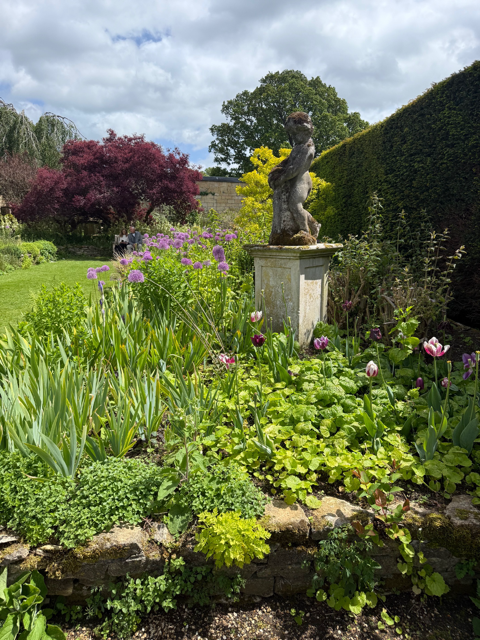
We enjoyed lunch at the Castle in a large private room decorated with medieval ornaments. Afterwards, we began a self-guided tour of the remaining gardens. (1) The White Garden is located on one side of St. Mary’s church. The beds are planted with white-flowering plants including tulips and roses. There are also topiary figures that represent Queen Katherine Parr and Lady Jane Grey. (2) The impressive Secret Garden is an intimate and sheltered space enclosed on three sides by old stone walls and the other by a Yew hedge. It has a cottage-garden charm where foxgloves, alliums and irises are planted. There are two purple smoke bushes and a large Judas tree generating pink flowers. Many flowers can be seen including daisies, roses, blue salvias, penstemons, Russian sage and clematis. (3) The Tudor Physics Garden includes a selection of plants that would have been grown during the 16th-century for medicinal purposes. There were many herbs planted with labels explaining their benefits, such as Chamomile (removes weariness and eases pain), and Common Valerian (alleys all pain, promotes sleep and there is a benefit against the plague). (4) The Herb Garden was created in 2011 and includes a topiary yew of Emma Dent relaxing with a book in a corner of the garden.
We departed from Sudeley Castle and drove to the last garden that we visited in the Cotswolds.
Bourton House
We arrived at Bourton House and enjoyed a brief introductory talk by the Head Gardener next to the Tithe Barn. Following, we had a self-guided tour.
Bourton House was originally built on monastic lands in the late 16th-century along with several different structures; the stone Brewhouse (now a charming small house), Stables with mullioned windows (currently two holiday cottages) and Coach House. The Tithe Barn, dating back to 1570, is one of the largest in England with its original intended purpose of storing the one-tenth of the farm’s produce tithed to the Church.
In 1708, the owner took down the original Jacobean house and built the present Queen Anne house. The current owners, Roelof and Cheryl Quintas, acquired the property in 2010. Although ownership of the property changed many times over three hundred years, the house remains largely unchanged and is still a private family home.
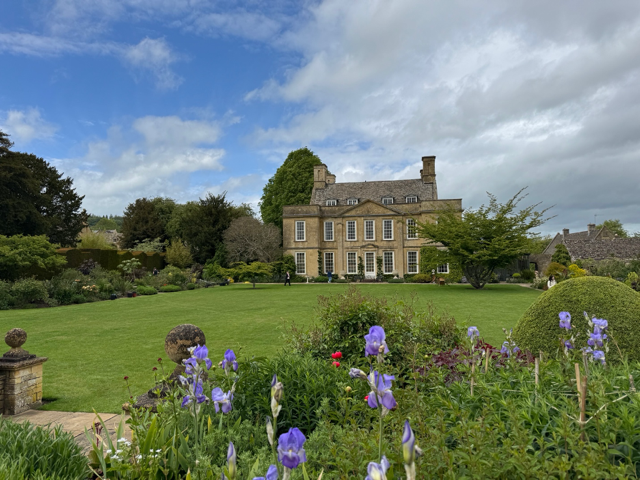
The natural landscape at Bourton-on-the-Hill has “sloping rises, fields with tumbling dips, majestic broadleaf trees and gathering spring water”. When considering the development of gardens, the philosophy of “adapting to the genius of the place, and… beauties not forced into it, but resulting from it” (Alexander Pope) was applied. The creation of the 18th century Raised Walk is evidence of this approach whereby the south edge of the lawn draws in the landscape and extends the vista into the distance.
The terraces on the south end of the lawn contain drifts of colors and textures with plenty to attract pollinators. The steps from the terraces lead to the historical Raised Walk providing a gorgeous view of the house and the surrounding landscape. Some of the plants on the raised terraces include different species of roses, peony, lavender, aster and verbena.
There is an expansive lawn on the backside (south) of the house enclosed by deep mixed borders of shrubs, annuals, tender and hardy perennials. The “warm” border contains plants that are known for their dramatically intense colors. The “cooler border” contains blues, and shades of purple and lilac. The borders are high maintenance with tender specimens. This is deliberate so that the garden continues “to get better and better well into autumn” compared to others where the gardens peak in early summer.
The West Lawn border continues toward the gated Fountain Garden. There is an exotic looking Tetrapanax papyrifer ‘Rex’ (Chinese rice-paper plant) with velvety leaves and stems that is thriving and doubles their height in a season. Other gardens on the property include the Knot Garden, Courtyard/Parterre, Fountain Garden and White Garden.
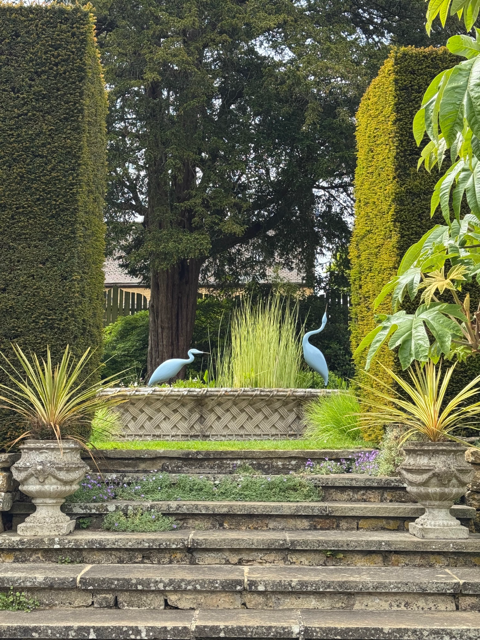
The clipping of evergreen plants into ornamental shapes has been known since Roman times. Topiary has also been used in French Renaissance gardens. In the 18th-century, topiary was unappealing as people were more interested in naturalized landscapes. However, it re-emerged in many fine gardens during the Victorian age using holly, juniper and laurel plants. Today, topiary Yew and Boxwood plants are seen in many English gardens like Bourton House.
Even though there were so many different rooms on the property providing us unexpected delight as we walked around the property, the Bourton House Garden has a very personal, welcoming feeling. It’s possible that the collection of plants were the appropriate number, variety and size for their given space and therefore contributing to our sense of delight and comfort.
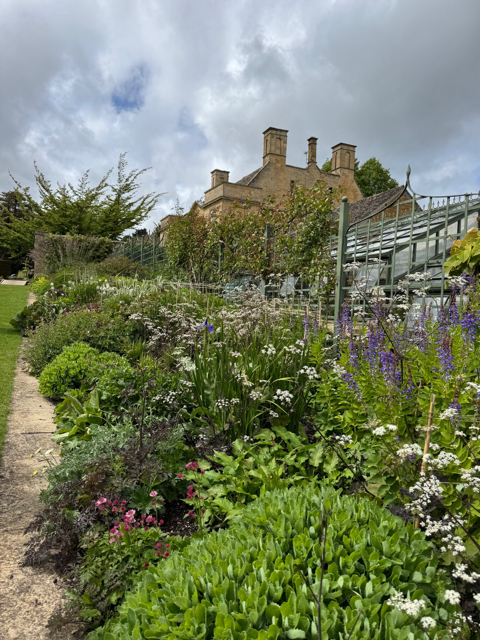
Before leaving, we all gathered for an afternoon tea and/or sweet beside the orchard and below the herbaceous borders. A lovely way to end our visit at our last garden in the Cotswolds, before departing for London!
Day 5 – Thursday, May 21st
The group traveled on the London Tube, arriving at the Chelsea Flower Show around 7:30am (doors opened at 8am). Early arrival was the best advice given!
Each year about 145,000 people visit the event held over several days. What an incredible experience to attend what is known as the “greatest horticultural show in the world”. It was an opportunity to immerse ourselves in extraordinary gardens and discover new ideas for our gardens. There were 30 grand “Show Gardens” and creative Container Gardens.
The Great Pavilion had the most extraordinary collections of plants. Many of us started our day in this location. We had the opportunity to talk with any of the 79 specialist nursery exhibitors, presenting an array of plants from hostas to giant trees. Also, there were breathtaking exhibits, including a fragrant walk through David Austin Roses and an extraordinary presentation of the mountainous region of Drakensberg depicted by Cape Flora of South Africa called “Life After Fire”. This South African exhibit received a gold award, the best exhibit in the Great Pavilion.
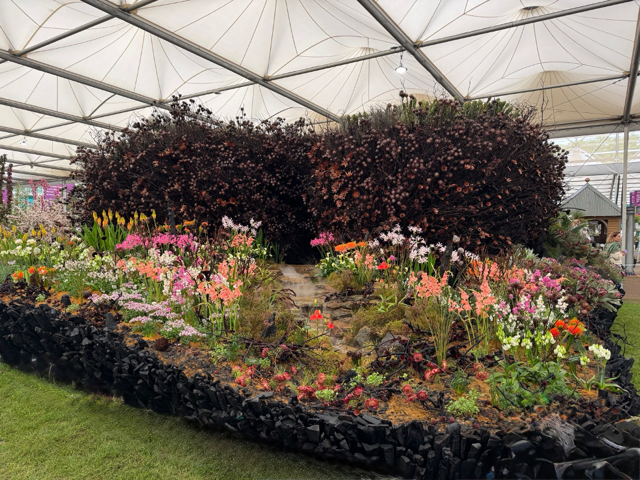
There were 23 floristry displays bursting with seasonal blooms in the Great Pavilion and around the Showground. The largest delphiniums and multi-colored geraniums were on display! In addition, an impressive 244 exhibition booths and boutiques were selling merchandise for gardens and home (furniture, greenhouses, garden sculpture, large ceramic pots, soap, tea towels, and more).
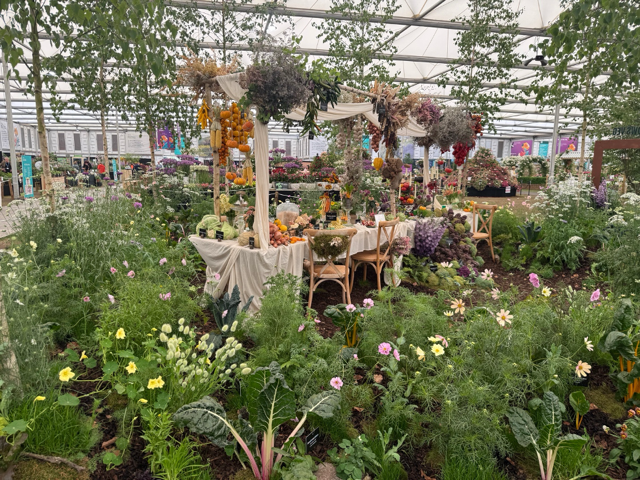
On average, 4,300 plants are grown for Large Show Gardens, 1,600 for Small Show Gardens, 1,100 for “All About Plants” and 200 for Balcony and Container Gardens. At least a third of these are grown as extras, so only the best plants are included in the final display.
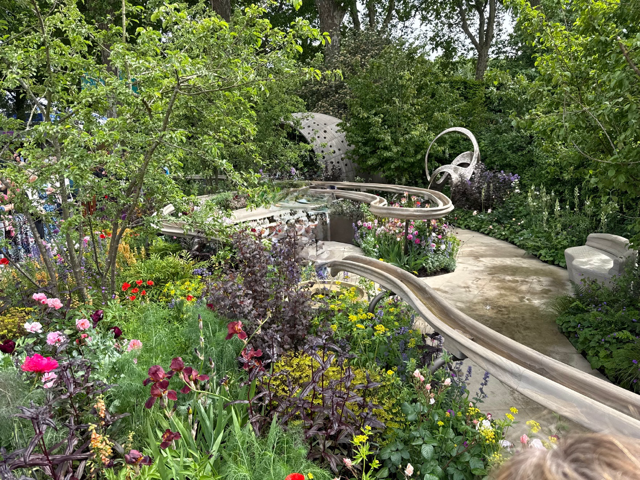
At the end of the Chelsea Flower Show, the Show Gardens are relocated. The RHS (Royal Horticultural Society) works with an organization called the House of Wayward Plants to “rehome” as many plants as possible. Also, visitors can purchase unneeded plants from exhibitor stands at 4pm on Saturday. Unfortunately, buying plants was not an option for us.
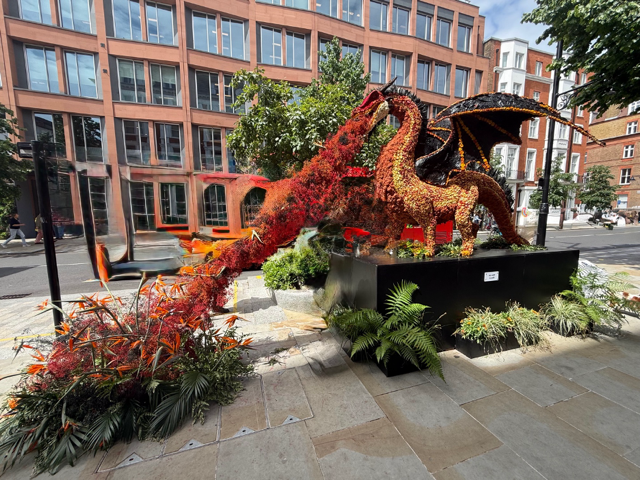
After leaving the Chelsea Flower Show, a group of us strolled around the streets of Chelsea admiring the many beautiful floral displays surrounding the store fronts and restaurants. There was a dragon display that was a standout! Also, the floral display around the entryway to the Willett’s Restaurant at The Cadogan Hotel was gorgeous!! Our lunch experience at this restaurant was also perfect.
The day continued for many with a visit to Buckingham Palace to see the largest exhibition of Queen Elizabeth II’s fashion. Later in the evening, most people went to the theater. A very full day with plenty to see and do!!
Day 6 – Friday, May 22nd
Our final meal was eating breakfast at our hotel (The Royal Garden Hotel, next to Kensington Park) before the group separated. Some people traveled back to Boston later in the day, while others were continuing to stay in Europe for additional traveling adventures.
What a fun, educational journey in the beautiful Cotswolds and at the impressive Chelsea Flower Show. It was an amazing opportunity to share stories and laugh along the way. An adventure enjoyed by all!!
Nan and Maryrose